
Harper County Court Records After Arrest
After a Harper County jail arrest, custody starts at the jail but the criminal case runs through Harper County District Court and the Kansas district court record system. The court is part of the Kansas 30th Judicial District. Local court materials list the district court at 201 N. Jennings Ave., 3rd Floor, Anthony, KS 67003, with phone 620-842-3721 and email allcourt@harpercountyks.gov.
The court record is not the same as the jail booking record. A booking record can show the arresting agency, intake time, hold basis, or bond status while the person is in custody. The court record shows the charges the prosecutor files, case events, hearings, warrants, dispositions, and sentencing results. For custody and booking details, use the Harper County jail inmate records workflow. For booking photos, use the Harper County jail mugshots page.
Find Harper County Court Records
Kansas Case Search is the statewide public district court record portal. Research notes show public district case information is available online through CaseSearch and at courthouse public terminals. General public use is described as open and free, while expanded access requires registration. For a Harper County arrest, search by defendant name or case number and then compare filed charges to the jail or bond information.
- Open Kansas Case Search.
- Search by defendant name or case number if the case number is already known.
- Confirm the county, party name, case type, and filing date before relying on the result.
- Read the charge list and docket events for filed counts, amendments, dismissals, pleas, or sentencing.
- Contact Harper County District Court if a public terminal, certified copy, or clerk help is needed.
The Kansas Case Search public portal is the court-search source documented in the image manifest.
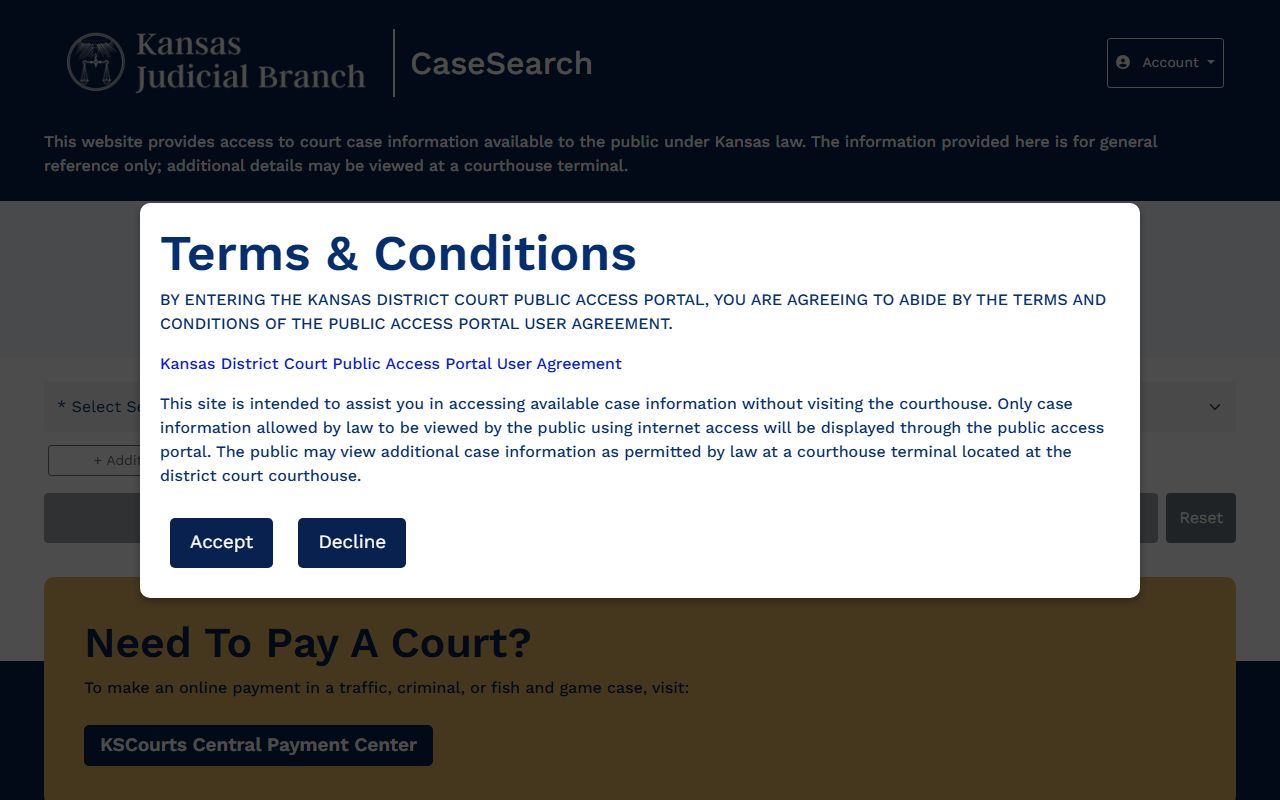
Use that portal for filed court events, not for live jail custody.
Harper County District Court Contacts
The local court page lists Chief District Judge William R. Mott, District Judge Gaten T. Wood, and Magistrate Judge Scott McPherson. Court staff listed in the research include Rachel K. Denton, Tonya Hummer, and Tabitha Stolsworth. Court services and community corrections have separate phone lines, which can matter after first appearance, bond review, probation, or diversion-related proceedings.
Harper County District Court
201 N. Jennings Ave., 3rd Floor
Anthony, KS 67003
620-842-3721
allcourt@harpercountyks.gov
Harper County Attorney
201 N Jennings Ave, 4th Floor
Anthony, KS 67003
620-842-6070
countyatty@harpercountyks.gov
The Harper County District Court page is the local source for court contacts and docket direction.
The court page is the local bridge between jail booking questions and case-file questions.
Charges Filed After Arrest
The prosecutor path matters because charges listed at booking may not be the same charges filed in court. The Harper County Attorney's Office, led by County Attorney Brandon Ritcha, evaluates law-enforcement referrals, files or declines charges, manages criminal prosecutions, and handles diversion where eligible. Once a charging document is filed, the court record becomes the better source for the case's official counts and status.
| Document | Who Uses It | What It Does |
|---|---|---|
| Complaint | Often filed by or through law enforcement and the prosecutor | Starts a criminal case by alleging an offense. |
| Information | Filed by a prosecutor | States formal charges without a grand-jury indictment. |
| Indictment | Issued through a grand jury | States charges after grand-jury action, used less often in routine local cases. |
The Harper County Attorney page identifies the prosecutor's office and notes DUI and criminal diversion programs.
That office is the local prosecution source after the arrest leaves the booking stage.
Harper County Charge Status
Charges can change as a case moves. A charge may be filed, amended, reduced, dismissed, diverted, or resolved by plea or trial. Kansas Case Search and the district court record should be used to understand filed charges. The jail may be useful for current custody and bond, but it is not the final source for what the prosecutor has filed.
| Status | Meaning in Plain English |
|---|---|
| Pending | The charge is filed and has not reached final disposition. |
| Amended | The prosecutor or court record changed the charge from its earlier form. |
| Reduced | The charge level or offense was lowered, often through negotiation or review. |
| Dismissed | The charge was dropped or ended without conviction on that count. |
| Diversion | The case may be deferred under agreed conditions, with details from the County Attorney. |
Bond After Harper County Arrest
No Harper County-specific bond payment page or jail fee schedule was located in official sources. Bond questions should be verified with the jail first, then with Harper County District Court if a court order controls release. A person may remain in custody despite an apparent bond if there is a no-bond order, outside warrant, probation or parole hold, DOC hold, ICE detainer, or federal hold.
| Release Term | How It Works |
|---|---|
| Cash bond | Cash is posted under the court's conditions. |
| Surety bond | A bonding company promises payment if the person fails to appear. |
| Own-recognizance or PR release | The person is released on a promise to appear and follow conditions. |
| No-bond hold | The person is not releasable on ordinary bond until the court or holding authority acts. |
Warrants and Arrest Records
No official Harper County active warrant search or most-wanted list was located on the sheriff or county pages. Warrant checks should use the local fallback chain: call the sheriff's office or jail at 620-842-5135 for local arrest-warrant routing, call Harper County District Court at 620-842-3721 for court-case and bench-warrant questions, and search Kansas Case Search by name or case number for public case events.
The County Attorney page includes a useful local scam warning. It warns about callers who claim a person failed to report for jury duty and must give personal details to avoid a bench warrant. Verify warrant and payment claims through the sheriff, district court, or official court payment routes, not unsolicited callers.
Charges vs Convictions
A Harper County arrest or filed charge is not a conviction. A charge is an accusation that begins or continues a criminal case. A conviction follows a guilty plea, verdict, or other final disposition that establishes guilt on a count. Public records can show both, so read the status line and disposition carefully.
| Charge | Conviction | |
|---|---|---|
| Stage | Accusation after arrest or prosecutor filing | Final result by plea, verdict, or judgment |
| Meaning | Not proof of guilt | Legal finding or admission of guilt |
| Where Seen | Jail, court, and prosecutor records | Court disposition and criminal-history records |
Sealed and Expunged Records
Kansas expungement law can limit public access to certain convictions, arrest records, and diversion records when statutory waiting periods and conditions are met. K.S.A. 21-6614 covers eligible convictions, related arrest records, and diversion agreements. Kansas Judicial Council materials also provide adult arrest-record expungement forms for arrest-record-only situations.
| Sealed | Expunged | |
|---|---|---|
| Public visibility | Hidden from ordinary public access | Removed or treated as cleared under the governing order |
| How it happens | Court order or restricted-access rule | Petition and court order under Kansas law |
| Important limit | Some agencies may still have lawful access | Eligibility depends on offense, timing, and case outcome |
Court Search vs Criminal History
Kansas Case Search is for public district court case information. The Kansas Bureau of Investigation / Kansas.gov criminal history search is a separate fee-based statewide criminal history record check. The research file notes a $30 purchase price and availability from 4:00 AM to midnight Central. Use the court portal for case events and the criminal-history channel when a statewide history check is the correct tool.
Important: Do not use casual public-record lookups for employment, tenant screening, credit, insurance, or other FCRA-covered decisions.